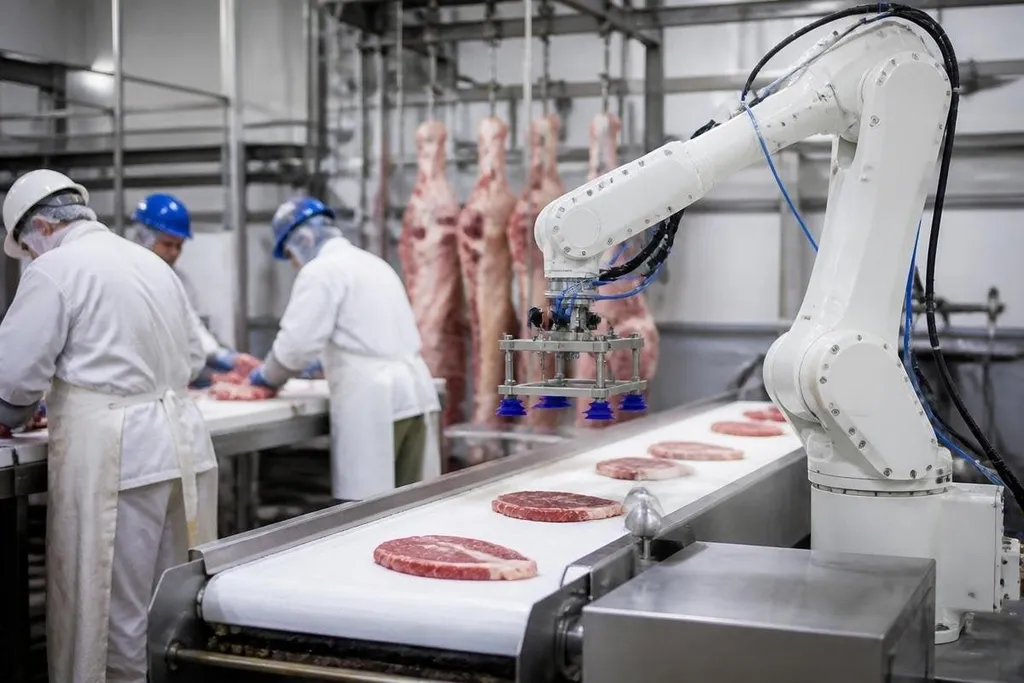
Meat processing combines sharp tools, wet surfaces, cold rooms, and products that vary in shape. Robots are taking on parts of that work where repeatable movement, machine vision, or controlled force can reduce strain and keep products moving.
For plant managers, the useful question is practical: which task fits a robot, and where does a person still need to make the decision?
- Robots fit repeatable handling, packing, sorting, and palletizing.
- Vision and force sensors help machines deal with changes in product position.
- Cutting and deboning remain harder because meat does not behave like a fixed part.
Where robots fit first
Robots work best when the task has a clear start point, a known handoff, and a repeatable motion. Picking trays from a conveyor, placing packs into boxes, and stacking finished cartons all fit that pattern.
The arm can repeat the same path for long periods, but it still needs information about each item. Cameras can locate products and check their position. Force sensors can detect contact, which helps the gripper avoid squeezing a soft pack too hard or pushing against a tray that has shifted.
End effectors, the tools attached to a robot arm, also change with the job. A vacuum tool may handle sealed packs, while a gripper with shaped fingers may hold a tray or carton. The tool has to match the surface, weight, temperature, and hygiene rules of the product.
What changes on the plant floor
Automation can move work away from the most repetitive parts of a line. A person may still load a station, check product quality, clear a jam, or change the robot tool, while the robot repeats the handoff between machines.
That division changes the layout. The plant needs space for guarding, access doors, sensors, washdown, and a safe route for staff. A robot that fits beside a conveyor on paper may need more floor space once those parts are included.
Cleaning also shapes the design. Food plants use water and cleaning chemicals, so motors, cables, joints, and control cabinets need protection suited to the room. A robot for a dry packing area may not fit a wet cutting or washdown area.
Those washdown limits matter when a plant moves from packing to cutting. A report from Robot 24 can name the robot, blade or saw, cut rate, and cleaning method, so you can see how the system handles meat between batches. Cutting also needs close control because bone, shape, and position can change from one piece to the next.
Why cutting is harder than packing
Packing gives the robot a fixed object and a known destination. Cutting asks the system to find useful boundaries inside a product that can shift, bend, and vary from one piece to the next.
A vision system may locate the outside shape, but that does not reveal every internal structure.
The robot also has to control tool position, cutting force, speed, and contact with nearby surfaces. Small errors can reduce yield or create a safety problem.
This is why automated cutting often uses a person, a specialist machine, or a tightly controlled product stream alongside the robot. Fully automatic work needs reliable sensing and a process that limits the range of shapes the system must handle.
The cost beyond the robot arm
The arm is one part of the purchase. A working cell may also need conveyors, cameras, grippers, guarding, software, washdown protection, and changes to the surrounding line.
Those parts affect the payback. A robot may remove a repeated lift from a packing station, but the plant still has to pay for maintenance, tool changes, cleaning, training, and downtime when the cell stops.
The plant should also plan for product changeovers. A system built around one tray size may need new tooling and software for another format. That work can decide whether a project stays useful after the first production run.
A practical buying check
Before choosing a system, check these points on the actual line:
- Record the task cycle and the number of product formats it handles.
- Check how often products arrive in the wrong position or overlap.
- Match the gripper and robot protection to cold, water, chemicals, and cleaning time.
- Leave room for guarding, staff access, tool storage, and fault recovery.
- Set a clear handoff for quality checks, jams, product changes, and maintenance.
- Ask what the robot does when its camera or force sensor cannot confirm a safe move.
I'd start with packing or palletizing before automated cutting. Those tasks give a plant a clearer test of uptime, cleaning, staff training, and line integration without asking the robot to judge every piece of meat.
The open issue is product variation. Robots can repeat a motion precisely, but a processing line still needs a plan for the piece that arrives in the wrong place, has a different shape, or cannot be handled safely.